
Author:Amy Torres

True Meditation is Without Effort or Purpose

Rupert Spira

The following essay is written by one of my favorite teachers of non-duality, Rupert Spira. Although Jesus in A Course in Miracles tends to use the word “practice” and “exercise” rather than “meditation,” he is always inviting us into the “quiet center” and the “stately calm within” which is meditation (only in workbook lesson 124 does Jesus explicitly use the word “meditation”).   Rupert’s view on meditation intersects nicely with Jesus’ view of  our natural state, and gives us another angle from which to relax into the truth of Being.

True Meditation is Without Effort or Purpose: Meditation as Being, Not Doing by Rupert Spira

You are already that for which you long. Meditation, in the deepest sense, is not a practice you take up or a discipline you perfect over time. It is the natural condition of being itself, available in every moment, prior to any effort or purpose. This essay explores what it means to rest in that condition and what stands in the way.

*****

Everything you do requires a degree of effort. And everything you do, you do for a reason – to bring about some change in the mind, the body or the world in the future. Meditation is an interruption of this flow of becoming.

If you are making an effort, you are in a state of becoming. If you are meditating for a purpose, for a reason, in order to acquire something, become something or understand something, then your meditation is taking you into the future. It is part of your project of becoming.

The mind is accustomed to always making an effort in order to achieve something. And it imagines that meditation is a refinement and a continuation of this project. And indeed, many meditation practices do give the mind something to do.

But what may be called meditation – or non-meditation – is not something you do or cease doing with the mind. Meditation is not what you do; it is what you are. Simply being.

How much effort does it take to be? And are you being for a reason or a purpose? Does the fact of being stand to gain or lose anything from the content of experience?

Ask yourself: am I being, or am I in a state of becoming? If there is any sense of becoming – meditating for a purpose, making an effort, trying to achieve something, even trying to achieve enlightenment or union with God – then you stand as the ego, the one who would derive some benefit from the effort.

Being is never enhanced or aggrandized by anything you might do or achieve. Being never wants to meditate. Being doesn’t want enlightenment. Being doesn’t seek peace. Being doesn’t want union with God.

If you are engaging in any of these activities, you stand as the one who feels a lack, who feels incomplete, and seeks something to complete or fulfil themselves. In other words, you stand as the ego, and your activity perpetuates that ego, that sense of separation.

There is nothing to do, nothing to achieve, nothing to become and nothing to understand. You are already that for which you long. Enlightenment is an idea created on behalf of the ego in order to keep it in a perpetual state of becoming – and, as such, to perpetuate its illusory identity.

The ego, the apparently separate self, can only exist in a state of becoming. So when you deprive it of the possibility of becoming, acquiring or achieving, it will feel redundant. It will feel like death to the ego. Indeed, it is a kind of death.

As a result, there may be some rebellion in your mind – a rebellion that persuades you to remain in a state of becoming. Don’t engage with this rebellion. Don’t do anything to it. Meet it with your understanding.

In time, the project of becoming gives way to the peace of being. The object-knowing mind that lives in a perpetual state of becoming will consider simply being to be boring. It will project a blank state onto being and experience it as boredom. And in an attempt to escape the discomfort of this boredom, it will do one of two things: escape into thinking, or fall asleep.

These are two subtle means of avoidance. If you are bored, don’t escape from it into thinking or sleeping. Sink down deeper. The peace of being lies just beneath your boredom. Boredom is like a blank screensaver that appears after all your other programmes have closed down, seeming to prevent you from seeing the screen as it is. Boredom is a blank state of mind that exists after the other states of mind have subsided, a thin veneer over the peace of being.

It is not so much that there is no effort, no practice, no purpose, but rather that there is no entity left on whose behalf any such effort, practice or purpose could arise. No one left to say: I want to be enlightened. I want to meditate. I want union with God. I want happiness.

‘I said to my soul, be still and wait without hope. For hope would always be hope for the wrong thing.’¹

Anything you search for, anything you long for, would always be the wrong thing, because it would always be an object or a state, and as such it would always disappear. Even if it were found, it would be lost.

In meditation – in non-meditation – the great search comes to an end: not a disciplined end, not a forced end, but a natural end. An end that is the natural consequence of understanding.

The project of becoming is outshone by the peace of being.

1  T.S. Eliot, ‘East Coker’, Four Quartets (1943).

Read More
Hall of Mirrors

I had a spiritual experience not long ago, brought on by illness.  I was in a weakened condition, which loosened my psychological defenses, and I welcomed that.  It actually felt good to be released from the tightly knit mental ego organization that claimed to ensure my personal safety.

As the great spiritual master, Mooji, says, “Sometimes the physical challenges of your health deteriorating can be a tremendous aid to discovering your own Self!”  He explains that when ill, we can become more luminous, more humble.  Indeed, I found that in this woozy, yet deeply relaxed state of mind, came an Insight:

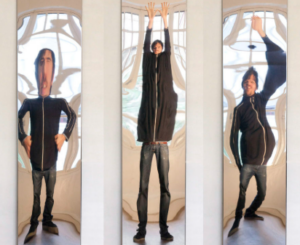
I was at an amusement park, on line to buy a ticket for the Hall of Mirrors.  After receiving my ticket, I pushed through a turnstile, and walked a short path up to the doorway.  Through the door was a maze of hallways, the walls covered in distorting mirrors.  I knew if I looked in the mirrors, the body would be seen as frighteningly warped, malformed and misshapen.


I suddenly knew it was not fun to be in the Hall of Mirrors.  Everything there reinforced its own distorted, self-enclosed reality.  But there seemed to be no way out.  I tried to reverse course by cautiously walking backwards to retrace my steps.  After all, I had not entered very far.  I still had my ticket in my hand.  I would return it and exit the way I came.  But when I backed into the turnstile, it would not budge.  It was only an entry point.

It struck me that the Hall of Mirrors was what A Course in Miracles calls propaganda for itself, “Thus is all questioning within the world a form of propaganda for itself.” ~ACIM, T-27.IV.5.  Once inside, there is no way out.  Within the Hall of Mirrors, all perspectives are refracted through fear.  But, thankfully, as Jesus points out in the Course, the ego may be “fool-proof, but it is not God-proof”.

Before despair set in, Something made me look up.  In the ceiling of the Hall of Mirrors was a skylight, and, somehow, it was possible to parachute upwards.  All I had to do was choose the resurrection route.

“A miracle inverts perception which was upside down before, and thus it ends the strange distortions that were manifest,” explains Jesus, ACIM, W-pII.13:2-3

Trapped within the ego thought system, my only choices seemed to be forward or back — on a horizontal time line.  When I turned to the memory of God within, a vertical option arose: the choice to elevate and see with the Holy Spirit’s Vision.  “…the miracle entails a sudden shift from horizontal to vertical perception.” ~ACIM, T-1.II.6:3  In a holy instant, there came a sense of uplift, light as dandelion seeds in a breeze.

Clarity dawned.  While thinking with the ego, I was stuck in a hall of distorting mirrors.  When I truly chose to leave the Hall of Mirrors, a miracle surfaced.  “For the memory of God can dawn only in a mind that chooses to remember, and that has relinquished the insane desire to control reality.” ~ACIM, T-12.VIII.5

All that is required is awareness of fear, so rather than being manipulated and consumed by fear, fear can serve as a reminder to choose again.  As we acclimate to fear, we can respond rather than react.  We can notice, aaahhh that quickness of breath, those sweaty armpits, those fidgety fingers and clenched toes, that rapid heartbeat, that pressure in the head, all these sensations are variations of fear, trying to consume my attention.  But wait!

I can acknowledge these sensations without following them down the rabbit hole of fear.  I can to move my attention to my Inner Spark, I can choose the memory of God within.  I can notice my experience shift to a smooth brow, lips upturned in a smile, exhale with relief, inhale more fully, and relax, rest in God, be still and Know.

Exalted.  Unified.  Fear-less.  Limit-less.  Time-less.  Beauti-ful.  Joy-ful.  Wonder-ful. Amen.

Read More

Forgiveness (some thoughts) by Peter Russell

I have appreciated Peter Russell’s work for many years now. He has a gentleness and humble intelligence that comforts and shines. Here is a piece on Forgiveness written by Peter.  It is not based on A Course in Miracles, so take what you like and leave the rest.  There is a lovely accompanying short meditation that can be found via his website: peterrussell.com

Forgiveness doesn’t always seem easy.  If someone has said or done something that has hurt us, forgiveness may feel like we’re letting them off.  “You did wrong, but I’m not going to punish you this time.”  But true forgiveness is far from letting someone off — or even thinking they did wrong.  It can be a profound healing process for both parties.

In the Bible, the Greek word that’s translated as “forgive” is aphesis.  Its literal meaning is “‘to let go” — to physically let go of something, as when we let go of a rope, or a rock, for example.  We’re releasing our grip on it.

With forgiveness, we are releasing the grip our mind has on some past event or experience.  We’re letting go of the judgments and grievances we’re holding; letting go of our beliefs about how others should have behaved or how they’ve done wrong.

When someone doesn’t behave as we expected, or as we would have liked them to behave, we might well feel angry.  It’s easy, then, to think that the other person has made us angry.  We make them responsible for our feelings.

But when we look  more closely, we often find that our upset comes from our interpretation of their behavior.  We’re telling ourselves a story about what happened, how they were wrong, and how they should have behaved.  So instead of saying they have made us angry, it would be more accurate to say we’ve made ourselves angry by how we judged their behavior.

True forgiveness comes from letting go of the judgments we’re holding — releasing the grip they have on our mind.  It’s something we do for our own benefit as much as for the other person.

One thing that can help is to put ourselves in the other person’s position.  If we could truly understand their motives — why they did what they did, what they might have been thinking and feeling, their own background and conditioning, their fears and pain, and the judgments they might have been holding about us — then we might begin to understand why they acted as they did.

We can begin to recognize that although they may not have behaved as we think they should have, they were, in a sense, behaving exactly as they should have — given all the factors that led up to their actions.

Forgiveness begins when we recognize that the other person was, deep down, wanting exactly what we want.  In their own way, they were seeking to ease their suffering and be more at peace.  But they went about doing this in ways that happened to impede our own search for peace.  Putting ourselves in the other person’s shoes fosters understanding, which leads to empathy and compassion.

This is not to imply we should accept someone’s bad behavior, or even condone it.  We may well feel the need to give them feedback, or make suggestions as to how they might behave better, but let’s do so with a compassionate heart, rather than from a judgmental mind.

Thank you, Peter Russell!


Read More

Recognizing Happiness by Daily Om

Daily Om is a platform full of wisdom and generosity. They offer a diverse array of online courses for minimal cost, and I have gratefully partaken of their offerings for years.  Here’s one for you:

When we take the time to recognize when we are happy and what that feels like, it becomes easier to recreate.

Those of us on the path of personal and spiritual growth have a tendency to analyze our unhappiness in order to find the causes and make improvements. But it is just as important, if not more so, to analyze our happiness. Since we have the ability to rise above and observe our emotions, we can recognize when we are feeling joyful and content. Then we can harness the power of the moment by savoring our feelings and taking time to be grateful for them.

Recognition is the first step in creating change; therefore, recognizing what it feels like to be happy is the first step toward sustaining this feeling in our lives. We can examine how joy feels in our bodies and what thoughts run through our minds in times of bliss. Without diminishing its power, we can retrace our path to discover what may have put us in this frame of mind, and then we can take note of the choices we made while there. We might realize that we are generally more giving and forgiving when there’s a smile on our face, or that we are more likely to laugh off small annoyances and the actions of others when they don’t resonate with our light mood.

Once we know what it feels like, can identify some of the triggers, and are aware of our actions, we can recreate that happiness when we are feeling low. Knowing that like attracts like, we can pull ourselves out of a blue mood by focusing on joy. We might find that forcing ourselves to be giving and forgiving, even when it doesn’t seem to come naturally, helps us to reconnect to those positive feelings. If we can identify a song, a picture, or a pet as a happiness trigger, we can use them as tools to recapture that bliss if we are having trouble finding it. By focusing our energy on analyzing happiness and all that it encompasses, we feed, nurture, and attract more of it into our lives — eventually making a habit of happiness.

To explore their offerings, go to dailyom.com

Read More

For those of you who do not have children, on Mother’s Day

For those of you who do not have children, this is for you on Mother’s Day. It’s from my human heart to yours. I trust it is infused with the divine love of the Divine Mother, but no preaching, no teaching, just heart-to-heart caring.

If you do not have children, and find Mother’s Day a painful reminder of that, I am here to hold your hand.  Maybe you have nurtured and, yes, mothered people, but no one counts you as a mother, because you do not have children.

Maybe you have taken yourself for granted, and not even realized how many lives you have warmed … even in a brief encounter, smiling at a stranger on the bus or in an elevator, and very likely, changed the entire course of their day.

How many times have you reached out a hand, yet no one celebrates you on this day?
Perhaps you continue to celebrate your own mother, yearning to have children but not sure that will ever happen … who understands this?

I want you to know that I do.

Maybe you were born male, but identify as female, and no one ever appreciates you on Mother’s Day.

I want you to know that I do.

Maybe you have had a stillbirth, miscarried, had an abortion … or worse … and, if anyone knows, they don’t know what to say. Especially today.

I say to you, with tears in my eyes, and a tender ache in my heart, I see you, I feel you, I appreciate you. You are beautiful. You are important. I care about you on Mother’s Day.

It is impossible that you have never mothered anyone,
so if you want to savor that title today, I say to you, “Thank you for your kindness, your nurture, your unsung deeds. Happy Mother’s Day.”

To those of you who have never given this a thought, please, think about it now. Open your heart to someone who may need to hear, “Happy Mother’s Day.” Look in their eyes when you say it, and show them you mean it.

We all need to be celebrated.
What about those of us who have nurtured and given selflessly but never had children, for one reason or another? What’s the name of the day that celebrates us? Maybe we should come up with one.

In the meantime, give the sweetest, most delicious gift you can give today … “Happy Mother’s Day” to all who deserve it — not just the obvious choices.

Love, Amy

Read More

Nirvikalpa Samadhi

In A Course in Miracles, Jesus uses metaphors to speak with us in human language in order to elevate us beyond the self-imposed limitations of humanity to a recognition of our deeper Knowing of what is truly True. Jesus speaks of the ladder we descended from Heaven to earth and how to retrace our steps back to the Real World.

The Real World, in A Course in Miracles, is the highest rung of the imaginary ladder we descended; the closest rung to the Kingdom of Heaven. God, we are told, takes the final step, and lifts us up to Him from there. The story of the yogini, which Mooji tells, below, is a variation of the ladder metaphor. The yogini’s experiences are like climbing the rungs of the ladder back Home. Nirvikalpa Samadhi is the heavenly state of absolute union with God.

Read the story with your heart and let it transport you through your soul all the way to Undifferentiated Spirit.

Beloved MOOJI tells a story:

A great Yogini was deep in meditation.  Suddenly, beautiful and melodious sounds could be heard, appearing as if from nowhere and everywhere simultaneously.  It was like nothing she has ever heard.  She felt: this music is truly wonderful but it cannot be what I am for I am here to hear it.  The music faded away.

Next appeared the most exquisite colours, like no painter could paint; nor could any flower display it for it was not of this earthly realm.  She thought: this is, indeed, astonishingly beautiful.  However, it cannot be who I am nor can it be real for it cannot appear if I were not here to perceive it.  This phenomenon, too, she ignored.

Shortly afterwards, it also vanished in the presence of her deep and unmoving silence.  Shortly after this, there appeared several beings shaped as if from pure light, floating through space and smiling lovingly at her in a welcoming manner.  She felt profoundly touched and filled with loving emotions but inwardly, she somehow, kept her composure.  “How profound,” she felt, “but this also cannot be what Is the unchanging reality, for, were I not here, who would see them?”

As soon as this insight occurred, the figures vanished.  Her mind entered her heart and could no more produce any effects.  A deep silence prevailed as her mind merged inside her indivisible, unconquerable and essential being — a state known to the Yogis as Nirvikalpa Samadhi.

Read More

The Kitten Story

I had just parked my car in a local shopping center to run some errands when I saw a tiny kitten pawing at the window of Burger King. Now I don’t know about you, but kittens in distress leap to the top of my “to do” list.

"You are the kitten," said the Holy Spirit.

“You are the kitten,” said the Holy Spirit.

My heart propelled me toward the wee creature, but I tried to casually saunter so as not to alarm her. She let me come close but then eluded me when I reached out to pick her up. I cooed soothingly, assuring her she was safe and that food and shelter awaited her if she came with me. She backed away.

So I returned to my car, went and got some cat food, came back and put a plate under a bush outside the Burger King. Then I sat in my car and waited. Sure enough, she sniffed out sustenance and ventured to nibble at the kibble.

It just so happens it was my birthday, and a bright beam of happiness surged through my heart as I watched the kitten eat. This little darling was my birthday present! I was going to take her home. I had found Smudges, my adorable orange cat (assuredly my boyfriend in a past life), in a parking lot eight years before. It must be my karma to find irresistible kittens in parking lots from time to time.

While the kitten took nourishment, I tiptoed up to her and just as I was an arm’s length away, she nimbly evaded me and darted off. I hightailed after her. She was faster than expected. Dodging from bush to bush, she quickly disappeared. I waited. And waited. And waited. But she did not reappear.

Heart heavy, I finally left. And returned every day for three days after that, bringing food, leaving my phone number with the Burger King manager (who confirmed this kitten had been hanging around), and waiting to see if she materialized. To no avail. That was the last I saw of her.

With a big sigh, on Day Four, I asked the Holy Spirit why It took away my birthday present. After all, I didn’t encounter the kitten on just any day — it was my birthday! And Holy Spirit said, “The kitten wasn’t your birthday present. You were playing my role with the kitten. As Holy Spirit, I offer you safety, sustenance and unconditional love every day. And every day you run away. Your birthday present is realizing you are the kitten!”

Can you beat that? I was offering the kitten safety, sustenance and unconditional love. Even though it was hungry and asking for help, the kitten didn’t recognize help from me, was afraid and ran away. Now the Holy Spirit was telling me that every day, when I turned to It with willingness and asked for Guidance, when It offered me safety, sustenance and unconditional love, I was afraid and ran away!

Yes, it was true. I had willingness to reject ego and connect with the Holy Spirit, but when Spirit responded, something in me snapped shut, turned tail, and bolted. Asking for Help was one thing, accepting Help was another.

Acceptance requires the ability to slow down and catch myself before snapping shut. Which depends on my ability to trust that the Holy Spirit is not a threat. Ego prompts me to panic. Remembering the kitten allows me to laugh at that faulty cue and remain open to the Mind through which Peace is experienced. Amen.

“As the light comes nearer you will rush to darkness, shrinking from the truth, sometimes retreating to the lesser forms of fear, and sometimes to stark terror.  But you will advance, because your goal is the advance from fear to truth.  The goal you accepted is the goal of knowledge, for which you signified your willingness.  Fear seems to live in darkness, and when you are afraid you have stepped back.  Let us then join quickly in an instant of light, and it will be enough to remind you that your goal is light.” ~ACIM, T-18.III.2

Read More

Direct Experience Via the Five Senses by Rupert Spira

“There is a kind of experience so different than what the ego can offer that you will never want to cover or hide it again.” ~ACIM, T-4.III.5:1

In this video, Rupert Spira simply, and brilliantly, walks us through a different kind of experience that intersects neatly with where Jesus points us in A Course in Miracles.

If you found this investigation compelling, you can follow up with The Miracle of Experience, also by Rupert Spira.

Read More

Are “Psychic” Powers Desirable?

In the third book of A Course in Miracles, the Manual for Teachers, section 25 is titled, “Are ‘Psychic’ Powers Desirable?” In this section, Jesus explains that, technically, the only real power is of God, however, in the process of encountering the Loving Power which is always Here Now, psychic abilities, when used purely for the purpose of awakening, can play a valid part.

Two teachers who are gifted with psychic communication and share it with loving integrity are Gina Lake (attend her Christ Consciousness transmissions and see for yourself) and Kristin Kirk, who gives a much needed Non Dual Explanation of Communication with Non Physical Beings.

Exploring psychic phenomena and spirit guides is not for everyone. Only if you feel a pull in that direction, need you go further. Otherwise, it’s one less thing to distract you as you follow Jesus’ pointing throughout A Course in Miracles.

Read More